
Using this thought record worksheet, a client learns to catch the thought behind a sudden change in mood, tell it apart from the feeling, and then test it against the facts. It follows the order CBT manuals teach, catching thoughts on a short log before testing one thought in full.
Feelings and belief get a rating from 0 to 100 each time, and the client stars the strongest feeling and the hot thought. Those numbers show you both which thought to work on and how far it moved once the evidence was weighed. Before the next session, the client looks back over the week’s records and writes down what helped and what to ask you.
Thought Record Worksheet: Catching, Testing and Review


At a glance
- When to use: from the early sessions of CBT for depression, anxiety or low self-esteem, introduced in session on a recent event and then practiced between sessions
- Ages: adults and older teens
- Who fills it in: the client, between sessions, with you going over each record at the next session
- Stages: Catching Thoughts for a week or two, then Testing a Thought on one hot thought at a time
- Ratings: each feeling and belief in the hot thought, 0 to 100, before and after the evidence, and belief in the balanced thought
- Capacity: a whole landscape page for each situation on Testing a Thought, and as many copies of pages 2 and 3 as the client needs
- Based on: the seven-column thought record in Mind Over Mood and the thought diaries of the Centre for Clinical Interventions
- Format: fillable PDF and Word (.docx), US Letter landscape, 5 pages
What’s in the Thought Record Worksheet
The client learns the method from a teaching page with an example row already filled in, including the rule that sorts a feeling from a thought. On the log, they catch a week of thoughts with their feelings and ratings. On the full record, they test one hot thought against facts on both sides and end with a balanced thought and a second set of ratings. In a short review, the client gets the week ready for your next session, and your own page includes notes on when to move from one stage to the next and what to look for in a record. The parts come into use at different points over the weeks of practice:
| Part | Page | When it’s used |
|---|---|---|
| How a thought record works, with an example row | 1 | In the session where you introduce it, with the client |
| Catching Thoughts | 2 | By the client, soon after a change in mood, before any thought is tested in full |
| Testing a Thought | 3 | By the client, on one hot thought, once catching comes easily |
| Looking Back | 4 | By the client, before the next session |
| For the Therapist | 5 | By you, before you set the first record |
How the Thought Record Worksheet Works
The log and the full record share the situation, feelings and automatic thoughts columns. A thought caught and rated on page 2 can be tested on page 3, rated again there, and compared on page 4. Osborne Dudley, a fictional high school band director, began his records in the week a parent emailed him about a trumpet solo, and we’ll take the pages in the order he met them.
How a Thought Record Works
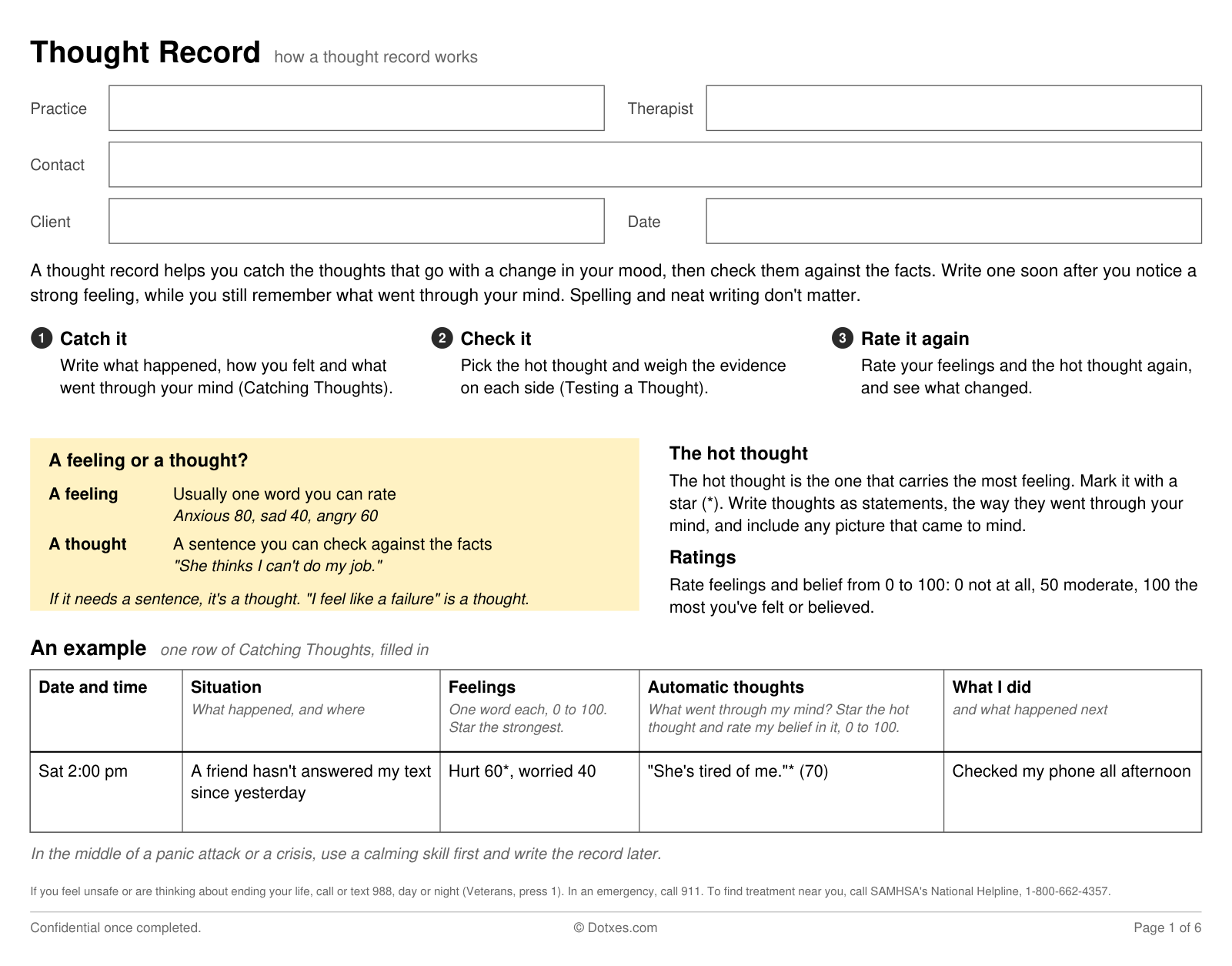
Page 1 is for the session where you introduce the record. Its three steps are catch it, check it and rate it again, and its example row comes from someone else’s week, about a friend who hasn’t texted back. The client can copy its shape without borrowing its content.

- A feeling or a thought? A feeling is usually one word that can be rated, such as anxious 80. A thought is a sentence that can be checked against the facts. The line under them uses “I feel like a failure” to show that a sentence starting with “I feel” can still be a thought.
- The hot thought, and Ratings. The hot thought is the one carrying the most feeling, marked with a star and written as a statement, along with any picture that came to mind. Feelings and belief are both rated from 0 to 100, with 50 as moderate.
- An example. A row of Catching Thoughts, filled in for a friend who hasn’t answered a text since yesterday. Hurt 60 is starred, “She’s tired of me.” is believed at 70, and the last column reads “Checked my phone all afternoon”.
At the foot of the page is a reminder to use a calming skill first in a panic attack or a crisis and write the record later.
Catching Thoughts
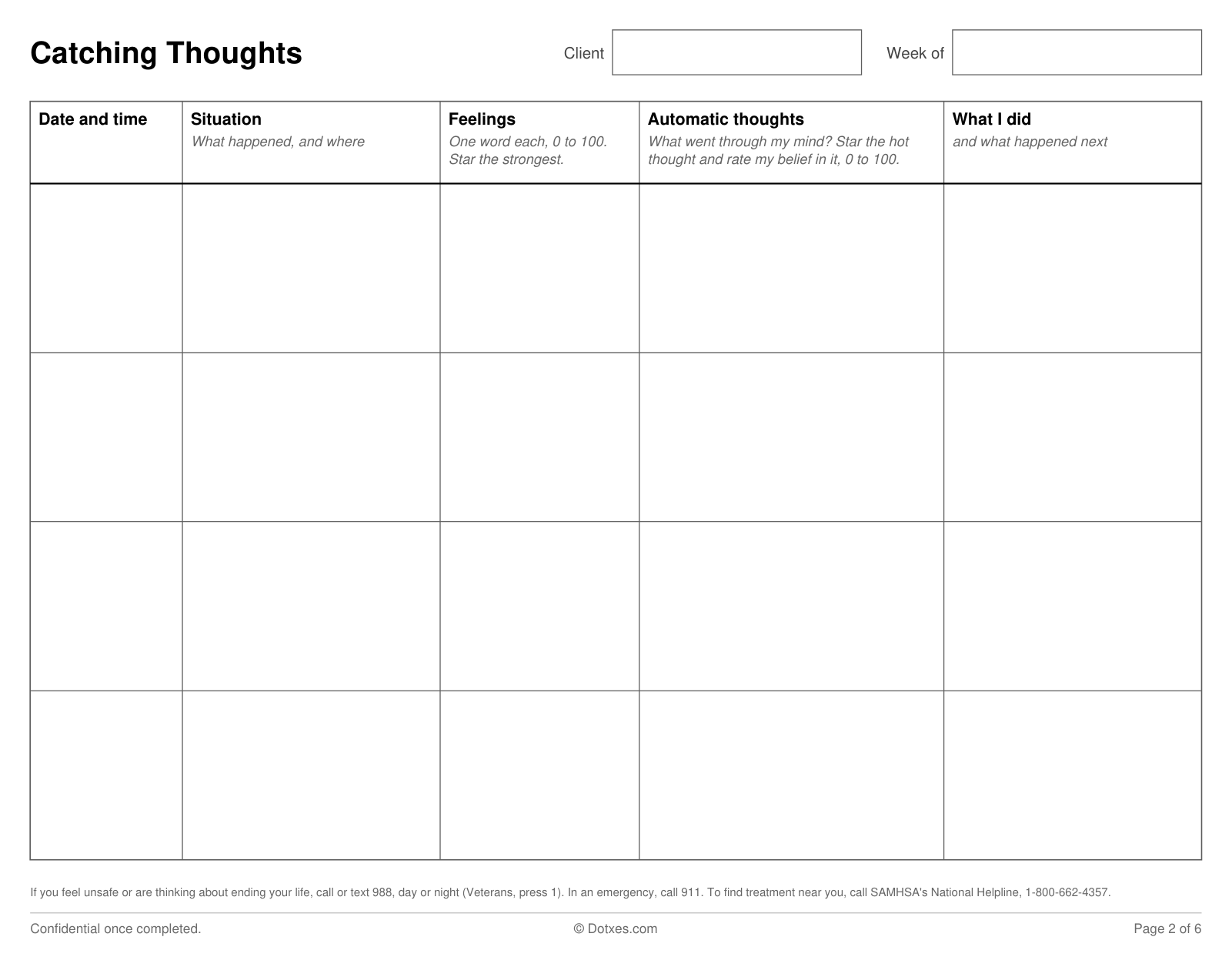
Catching Thoughts is the log a client keeps before testing any thought in full. In each entry the client writes the date and time, what happened, the feelings, the thoughts and what they did next, soon after the mood changed and while they still remember. Osborne made entries on Monday, Wednesday, Thursday and Saturday of the week of 11/08.

- Feelings. One word each, rated from 0 to 100, with the strongest one starred. After the parent’s email on Monday, Osborne wrote anxious 75, starred, and irritated 50.
- Automatic thoughts. What the client was thinking, with the hot thought starred and their belief in it rated. His was “She’ll go to the principal, and I’ll look unfair.” at 80.
- What I did, and what happened next. The action that followed the thought, and where it led. He reread his audition notes three times and missed dinner.
Testing a Thought
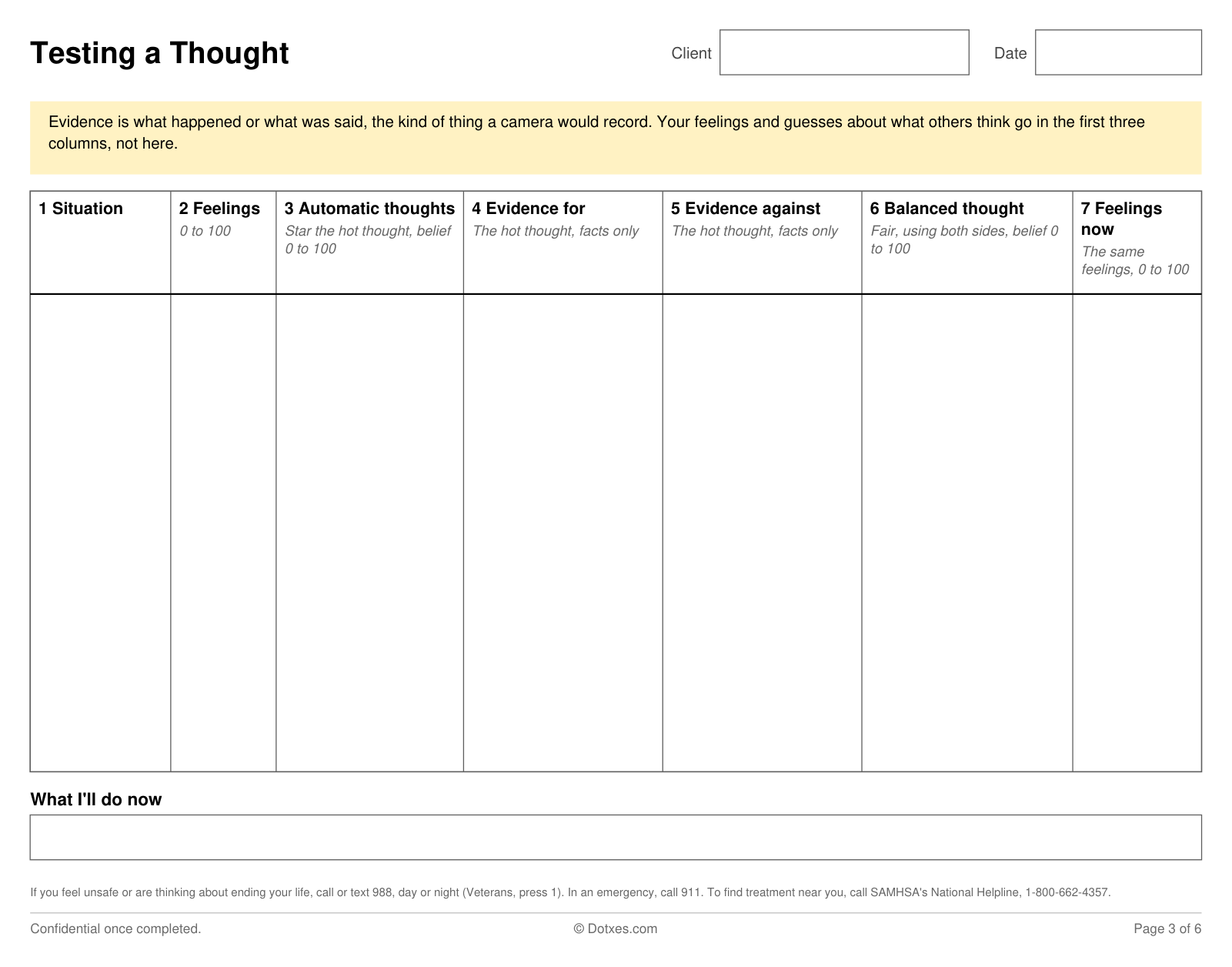
Testing a Thought has one situation to a landscape page, in seven numbered columns. Above the columns is a reminder that evidence means what happened or what was said, the kind of thing a camera would record. Feelings and guesses about what others think go in the first three columns. Osborne took Monday’s hot thought to this page the same afternoon.

- Evidence for, and Evidence against. Facts only, and both columns are about the hot thought. For it, the parent’s email said she was “very disappointed”, and she wrote to the principal last year about a field trip. Against it, her son placed third of five on a score sheet Osborne and his assistant director both signed, Principal Coburn backed his calls after two parent complaints last year, and her email doesn’t mention the principal.
- Balanced thought. A fair thought that uses both columns, with its own belief rating. His reads “She’s upset and might write to Coburn. My scores back the choice, and he backed calls like this last year.” at 70.
- Feelings now. The same feelings rated again, along with the hot thought. Anxious fell from 75 to 40, irritated from 50 to 30, and his belief in the hot thought from 80 to 35.
Under the table, What I’ll do now has room for one step. Osborne planned to reply the next morning with the scoring rubric and invite the parent to meet after school.
Looking Back
The client completes Looking Back from the week’s records before the next session. On it, they write how many records they did, the situations that came up most, what helped, what might get in the way next week and the questions they want to bring.

- Feelings before and after. Copied from columns 2 and 7 of Testing a Thought. Osborne wrote anxious 75 before, 40 after.
- Hot thoughts that came back. The theme across the week’s hot thoughts. For him, “People think I’m unfair, or they’re annoyed with me.”
- How likely I am to keep writing them next week. A rating from 0, not at all, to 100, certain, and Osborne rated it 80.
For the Therapist
Page 5 is your reference for this worksheet. On it are notes on when to move a client from catching to testing, the slips to look for in a client’s record, the research behind thought records and the clients who need a different approach, with room for session notes.
How to Use It With a Client
- Practice on a recent event in session. Fill in a row of Catching Thoughts together, from something that happened in the past week.
- Agree on the week’s log. Ask for an entry soon after a mood change, while the client still remembers what went through their mind.
- Move to the full record when the log comes easily. Once the client can tell a feeling from a thought and find the hot thought, pick an entry to test on page 3. Some clients are ready in their first week.
- Go over every record they bring. Look for feelings in the thought column, questions in place of statements, and opinions in the evidence columns.
- Open the next session on Looking Back. Read it together, and if the How likely rating is low, go back to what the client wrote might get in the way before you agree on the next week’s records.
Where the Thought Record Comes From
The seven columns follow Christine Padesky’s thought record from 1983, reprinted in Mind Over Mood. On it, the client circles the hot thought and writes facts, not interpretations, as evidence. Mind Over Mood and the Centre for Clinical Interventions both have clients catch thoughts on a shorter record first. Pages 2 and 3 keep that order.
In a 2012 study with 91 non-clinical participants, a single session of thought records improved beliefs and anxiety compared with a control session, and a single behavioral experiment did slightly better. In a 2025 study, 1,052 high school students read an example thought record and then completed their own in one digital session, and their belief in their negative thought dropped from before to after. Across 17 CBT studies, a 2016 meta-analysis found that the amount of homework clients did and the quality of it were both related to outcome at the end of treatment. The two relations were of similar size, though only 3 of the studies measured quality.
What It Can and Can’t Do
A thought record works on one thought at a time. Writing out a chain of worries or an OCD obsession can feed the cycle, and those clients need an approach made for them. A hot thought that returns week after week can point to a core belief. When low mood is present, ask directly about thoughts of suicide. The 988 and 911 numbers are set in small type along the bottom of every client page. These records name people from the client’s week and what the client believed about them, and it’s the client’s call who else, if anyone, reads them.
Make It Yours
- If the hot thought is a prediction about what will happen, set up a real-life test of it on the Behavioral Experiment Worksheet.
- When one hot thought shows up in record after record, look for the belief underneath it with the Core Belief Evidence Worksheet.
- For a client who gets stuck on evidence against, work through the questions on the Socratic Questioning Worksheet together.
- After a few weeks of records, name the patterns in the hot thoughts with the Cognitive Distortions Worksheet.
- In the PDF or Word, type your practice name and contact line into the page 1 header, and print extra copies of pages 2 and 3.
Frequently Asked Questions
Start from the feeling. Ask what went through their mind just before it, and have them write it down as a statement, in their own words. The example row on page 1 has one, “She’s tired of me.”, and the box above it says that if it needs a sentence, it’s a thought.
On page 1, the client reads that spelling and neat writing don’t matter. The notes on page 5 suggest calling it practice, keeping it short and starting with one record a week.
There’s no set number. Agree on one together and print more copies of Catching Thoughts when a page fills up. Pay as much attention to how carefully each record was done as to how many there are.
Look at the rating in column 6. The rule of thumb on page 5 is that a balanced thought believed at under 50 usually needs more evidence or a different hot thought. The balanced thought is meant to be fair to both evidence columns, and Osborne’s, at 70, admits the parent might still write to the principal.
Both evidence columns on page 3 are about the hot thought only, as in the Mind Over Mood record, where the client circles it before writing any evidence. Testing the thought with the most feeling behind it keeps the record on what drove the change in mood.
Sources
- Greenberger, D., and Padesky, C. A. (2016). Mind Over Mood, 2nd ed., Worksheet 9.2, Thought Record. Guilford Press
- Greenberger, D., and Padesky, C. A. (2016). Mind Over Mood, 2nd ed., Worksheet 7.3, Identifying Automatic Thoughts. Guilford Press
- Thought Diary 1. Centre for Clinical Interventions, Government of Western Australia
- Thought Diary 3. Centre for Clinical Interventions, Government of Western Australia
- McManus, F., Van Doorn, K., and Yiend, J. (2012). Examining the effects of thought records and behavioral experiments in instigating belief change. Journal of Behavior Therapy and Experimental Psychiatry
- Rozek, C. S., et al. (2025). A Brief, Affordable, Broad-Access Transdiagnostic Intervention (Project RE-THINK) for Adolescents: Quasi-Experimental Study. JMIR Mental Health
- Kazantzis, N., et al. (2016). Quantity and Quality of Homework Compliance: A Meta-Analysis of Relations With Outcome in Cognitive Behavior Therapy. Behavior Therapy
- 988 Suicide and Crisis Lifeline