
This anger coping skills worksheet for kids is for children about 6 to 12 whose anger gets big fast, and for the therapists and school counselors working with them. A child can learn how their anger feels at each level, pick the skill that cools it down there, and practice it at home with a grown-up.
A skill the child writes beside a level on the thermometer is the one their plan starts with when that level’s warning sign shows up.
Anger Coping Skills Worksheet for Kids: Thermometer and Plan


At a glance
- Ages: about 6 to 12; for a younger child, you write while they talk
- When to use: the first sessions of anger work, before the child practices skills at home
- Who fills it in: the child, with you for the thermometer and the cards, a parent for the plan, and a grown-up at home who initials the chart
- Parts: an anger thermometer with four levels, cool-down skill cards, a cool-down plan, and a practice chart
- Format: fillable PDF
What’s Included
Every part comes back to the thermometer’s levels, and on the chart you can see how far each skill brought the anger down. What the child writes is short throughout, a few words about their body, the name of a skill or a number from 0 to 10.
| Part | What the child writes |
|---|---|
| My Anger Thermometer | For each level from Calm to About to explode, how their body feels, what sets it off and a skill to try |
| My Cool-Down Skills | Their own way of doing each skill, such as their cool-down spot, plus an idea of their own |
| My Plan | Their first warning sign, the skill to try first and the next one, a grown-up who can help and a signal for a break |
| My Practice Chart | For each day, what made them mad, how mad before and after, the skill they used and a grown-up’s initials |
Filling In the Thermometer and the Plan
You and the child fill in the thermometer and the cards in session, and the plan with a parent or the grown-up at home there too. Each time the child gets mad that week, they mark the chart and the grown-up adds their initials. Grady Pruett, the 9-year-old in our example, filled in all four, and his thermometer is where he started.
Four Levels of Anger
Each level has its own row, with a number range and a few words a child can recognize, such as “Bugged or annoyed” for A little mad. The child starts at Calm and works up.

- The level. A little mad, 3 to 4, is the level where Grady first notices his anger.
- My body feels. “My ears get hot and my face goes red.” Under the heading, the hint is face, fists, heart, voice.
- I can try. “Belly breathing, five times.” At About to explode, Grady wrote a break in his room instead.
Making Each Skill Their Own
Each card has one skill in a few lines, with a box under it for the child’s version. Grady’s cool-down spot and his number of breaths are his own.
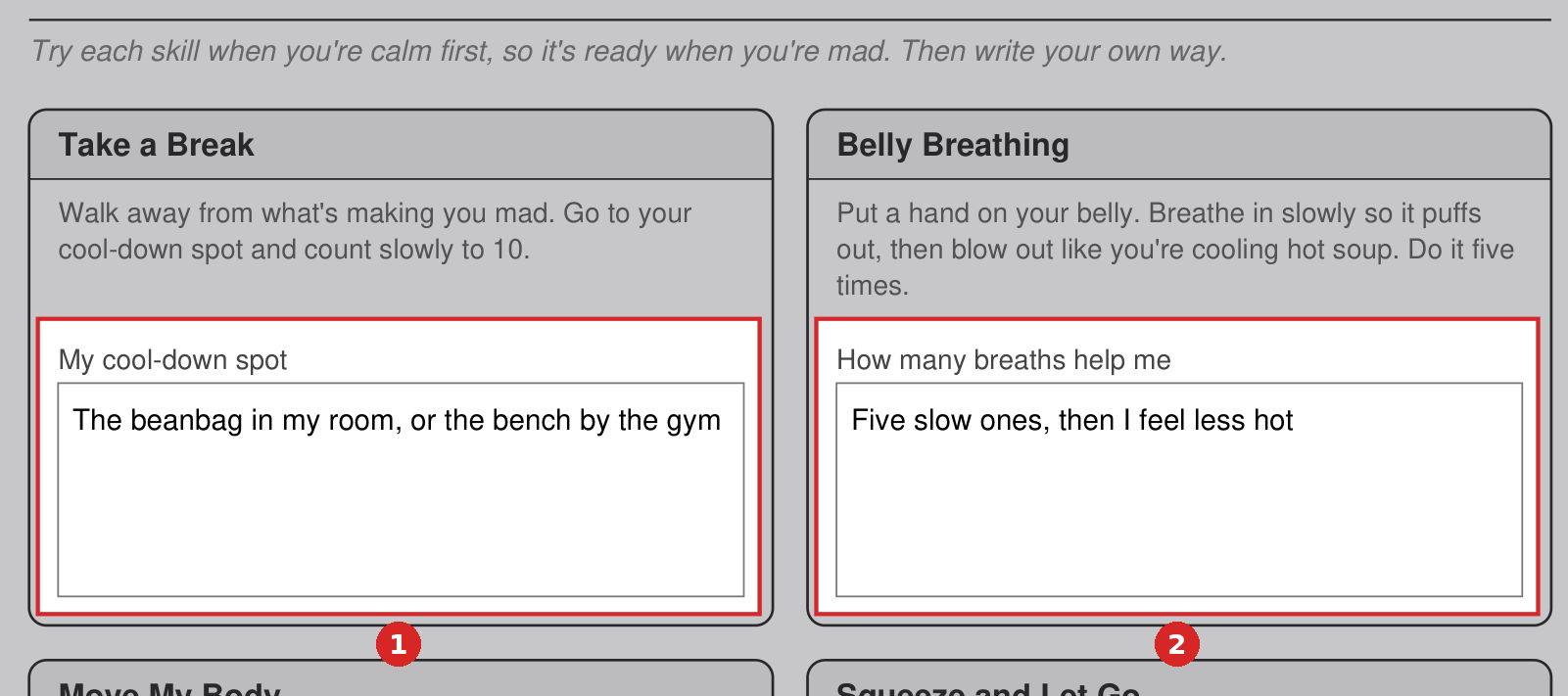
- My cool-down spot. “The beanbag in my room, or the bench by the gym.”
- How many breaths help me. “Five slow ones, then I feel less hot.”
Move My Body, Squeeze and Let Go, Talk About It, and Draw or Do Something Fun each have a box for the child’s own way too. At the foot of the page is a box for one more idea of their own, and Grady’s was a drink of cold water and a splash on his face.
The Plan

- My first warning sign. “My ears get hot,” the same sign Grady wrote at A little mad.
- First I’ll try. Belly Breathing, with Take a Break under If I’m still mad.
- Our signal for a break. “I say ‘pause’ and make a T with my hands,” a signal Grady and his grandma agreed on.
A Week on the Chart

- How mad. A 0 to 10 drop-down, with the thermometer’s levels behind the numbers. Grady’s ran from 4 to 8.
- How mad after. The same scale after the skill. His 8, when his sister Tessa knocked over his tower, came down to 4 after a break.
- The skill that helped most. “Take a Break. The beanbag works best when I go right away.”
Cooling Down in Session
- Fill in Calm first, while the child is calm, then work up the thermometer one level at a time.
- Write the child’s own words in the boxes, even when they’re short.
- Practice two or three skills in session before they go on the plan.
- Agree on the signal with the grown-up at home there, and show them the chart.
- At the next session, read the before and after numbers with the child, and swap a skill on the plan that didn’t bring the anger down.
The Anger Coping Skills Worksheet for Kids and CBT
Anger, irritability and aggression are among the most common reasons children are referred for mental health care, and CBT for them targets emotion regulation and social problem-solving, as Denis Sukhodolsky and colleagues describe in a 2016 review. The face and fists in the thermometer’s hint come from the questions on Nemours KidsHealth’s anger page for kids, and the lemon squeeze comes from a University of Washington relaxation script for younger children.
Adapting the Plan for Each Child
- For a child who worries more than they get mad, the Coping Skills Worksheet for Kids has a worry plan and a practice chart.
- When a child likes the lemon squeeze, the Progressive Muscle Relaxation for Kids script takes it through the whole body.
Frequently Asked Questions
Children about 6 to 12. A younger child can point to a level and say what happens, and you write it in their words.
That’s what the signal is for. When the warning sign comes, the child makes the signal, and the grown-up knows it means a break. The grown-up can then remind the child of the first skill on the plan.
Yes, with the parent’s agreement. The warning sign, the first skill and the signal are short enough to copy onto a card for the teacher.
Sources
- Sukhodolsky, D. G., Smith, S. D., McCauley, S. A., Ibrahim, K., and Piasecka, J. B. (2016). Behavioral interventions for anger, irritability, and aggression in children and adolescents. Journal of Child and Adolescent Psychopharmacology, 26(1), 58-64
- Taking Charge of Anger (for Kids). Nemours KidsHealth
- Fitzgerald, M. Relaxation Script for Younger Children. TF-CBT training, University of Washington